Teaching Portfolio
Gillian Rossi
Pre-Service Teacher, Primary Education
St.Francis Xavier University , 1st Year (2019)
Capacity With Non-standard Units
Grade 1: Measurement
*Estimate, measure, and describe capacity and/or mass of an object, through investigation using non-standard units


1
This is an exploration activity that involves three different stations (+ a bonus station) all looking at mostly capacity but also a little bit at mass.
The children should be split up into three equal groups after a minds-on discussion in a large group.
One example of a minds-on discussion can include a simple Powerpoint presentation!
Download "Will an Elephant Fit in a Bathtub?" Powerpoint Presentation


2
Station 1: Sorting by Capacity & Mass
Station 2: Estimation
Station 3: More than/Less than 1L
Gather up a bin with a whole bunch of different objects from around the classroom! Make sure to have a mix of objects that can be measured by weight/mass (marker, book, eraser, glue, etc.) and objects that can be measured by capacity (bowel, pencil case, cup, etc.).
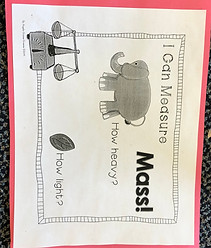
Ask the children to sort the objects and place them under the proper sign: Mass or Capacity!
BONUS STATION!

3
At this station, each child will get a worksheet. They will estimate how many scoops of fruit loops each container on the sheet can hold.
Then they will take a small cup and try it out! They will measure to see how close their guess was.
*Any material can be used to measure-rice, fruit loops, seeds, etc

Bonus
On one table, set up a big bin of water, with multiple sized containers around it.
On a separate table (in the picture) place signs for "Holds more than 1L", "Holds 1L" and "Holds less than 1L".
Use one 1L container as the example so children can use this container to compare and problem solve. The children will use the bin of water to help sort the containers. They can fill up a container with water and then dump it into the 1L example. If it overflows, it is more than 1L, if it does not fill it up, it is less than 1L and it it fills it, it holds 1L.
*Encourage the children to use "more than" and "less than" terms to explain their reasoning!
This bonus station can be done at the end of all the rotations, or if one group is done their station quicker than the others!
BONUS: Which container is holding the most water?
Children will write their name on a sticky note and place in front of the container they think is holding the most water.
THE TRICK? They are all holding the same amount of water!
